One of the places I wanted to visit during this trip to Kathmandu was Lalitpur, once known as Patan. It is one of the three ancient cities in the Kathmandu Valley, along with Bhaktapur and Kathmandu.
Lalitpur is famed for its metal and wood craftsmanship, and it didn’t take long to understand why. Our local guide spoke with pride when he said, “The finest artisans in Nepal come from here. Our carvings and crafts are more delicate than anywhere else.” His words carried a sense of heritage deeply rooted in the city’s identity. For centuries, Lalitpur, Bhaktapur, and Kathmandu have competed in beauty and prosperity, each showcasing its glory through art, temples, and architecture.
We began our walk at Patan Durbar Square, the historic heart of Lalitpur. The square is surrounded by Hindu temples, even though most of the city’s residents are Buddhists. There are two Krishna temples here, and interestingly, as a center of trade, the square also houses two temples dedicated to wealth and commerce, which are Laksmi and Bhimsen, the God of Trade and Business. The Bhimsen Temple stands out with its golden brass statues gleaming in the sunlight, a fitting tribute to a deity of prosperity.
From the square, we entered the old royal palace through Mul Chowk, where a shrine dedicated to Goddess Durga, which is kept behind closed doors. It opened only during major festivals. The goddess is flanked by two other deities, Ganga and Yamuna, both guard the entrance in silence. We continued to Sundari Chowk, where the royal bath lies hidden in a peaceful courtyard. Surrounding it are beautifully carved wooden windows known as one-eye windows. From the inside, people could watch the world outside, unseen. It is a quiet detail that says so much about the elegance of the past.
Our visit to the palace was cut short as we hurried to see the Golden Temple, about 500 meters away. This Buddhist monastery is still an active place of worship. The golden statues and intricate metal carvings glowed with reverence, each detail a testament to Lalitpur’s artistic soul.
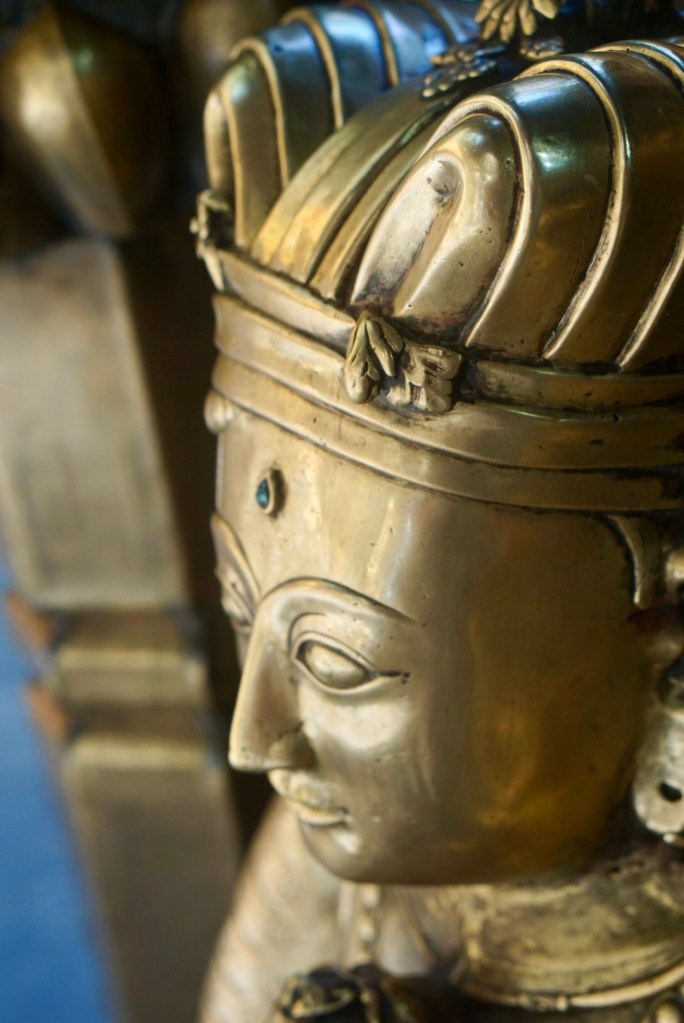
Everywhere I looked, there was something that drew me in, a pattern, a sculpture, a shadow cast on old brick walls. I could feel the pride of the people who have kept their craft alive through generations. It is easy to understand why they call Lalitpur the most beautiful among the three ancient cities of the Kathmandu Valley.
Half a day in Lalitpur felt far too short. If time had allowed, I would have stayed longer, wandering through its alleys, watching artisans at work, and listening to the rhythm of the city that creates beauty with its own hands.
Getting there was easy. From Kathmandu, Lalitpur is only a 15–20 minute drive. We booked a car through InDrive, choosing a comfortable air conditioned ride, we got a BYD that cost us around 500 NPR (about 63,000 rupiah). At the ticket gate, a friendly man approached and offered to be our guide. I told him we liked to take things slowly and enjoy taking photos. He smiled and convince me, “I can take good pictures, and I know the best photo spots!” He wasn’t exaggerating, he really did. For 2,000 NPR (around 252,000 rupiah), he guided us for three hours, and it was worth.
Lalitpur, with its timeless art and quiet dignity, left a lasting impression. Some cities whisper their stories softly and this one carves them in wood and bronze, for the world to see and remember.
As I left, I couldn’t help thinking how creation connects us, whether through chiseling metal, carving wood, or drawing lines on paper. Every craft begins with patience and devotion. Lalitpur reminded me why I draw and write: to preserve what words alone cannot hold, to translate beauty into something that lasts a little longer than the moment itself.
 a Professional Dreamer
Leave a comment